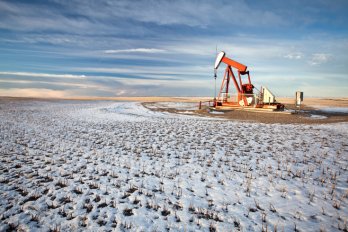
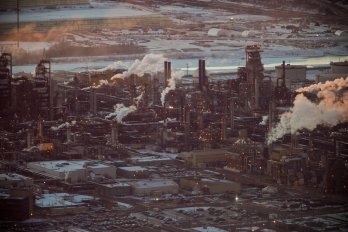
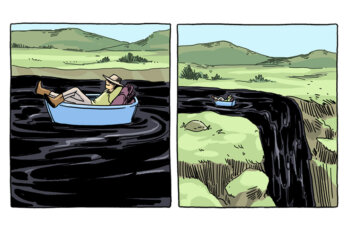
Alberta’s Athabasca Oil Sands Project can produce 155,000 barrels of crude per day. Its majority owner, Shell Canada, plans to increase that to more than 500,000 barrels per day (Source: “Amazon of the North” by Eamon Mac Mahon, November 2011).Last month, the Bank of Canada warned in its latest Monetary Policy Report that Canada’s oil industry is dragging down the nation’s economy because the country imports crude at higher cost than it exports. Nationally, we import an enormous amount of oil, both light and heavy crude, mainly from Algeria, the UK, Nigeria, Norway, and Saudi Arabia; in 2009, we brought in an average of 1.1 million barrels per day, compared to an export of 1.9 million barrels per day.* This foreign supply is bound for Eastern Canada, mostly going to the Atlantic provinces and Quebec, with a small quantity reaching Ontario. (Natural Resources Canada provides a good map of our existing oil pipelines.) With the difference in price between Canadian and international oil sometimes as great as 35 percent, CIBC and the Bank of Montreal estimate that the annual loss to the economy is nearly $20 billion. To reduce Canada’s reliance on expensive foreign oil, why don’t we ship heavy crude from Alberta to the refineries in the Atlantic provinces?
This question has excited the media and the energy industry from coast to coast. The Calgary Herald calculates that an eastbound oil pipeline would be a terrific investment, while Nova Scotia’s Chronicle Herald argues that it would be economically efficient. But these views may be mistaking the effect of an eastbound pipeline on oil prices — remember, oil companies are inherently driven by the expectation that those prices will rise. And using decades-old infrastructure for the endeavour presents a high risk of calamity. (more…)
WASHINGTON D.C.—What happens when corporate leaders and academic experts on energy, climate change, and geopolitics sit down and brief the United States Senate on how the US can “achieve a more secure, reliable, sustainable and affordable energy future”?
Just how does a country go about ending an addiction to oil? Are people actually working out the solutions to this? Curious about what the dialogue around energy policy in America actually is, I headed to the Senate Energy Committee’s September 12 summit on Capitol Hill to find out what it sounds and feels like to have these figures gathered in one room, dreaming up the future. You can watch the webcast or read about the testimony before the Senate Energy Committee from the major news bureaus (Reuters UK, The Guardian, Globe and Mail, Associated Press)— but for an in-depth analysis beyond what most news organizations are reporting, read on. (more…)
Why did Igor Kenk keep more than 2,800 bikes in storage?
That was the question posed by last Saturday’s front-page National Post article. Buried within the article was a possible answer: preparation for the apocalypse. “Det.-Const. Dennis says ‘Mr. Kenk told him ‘the apocalypse is coming.’ In the future when we have run out of oil, we will all need bikes to get around, the logic goes, and Mr. Kenk will have a few in storage to offer us.” (more…)